
Understanding the Factory as a Process
Why manufacturing performance depends on how people, machines, processes and information work together
Manufacturing has never had more technology, information or process control. Factories now operate with automation, ERP and MES platforms, connected equipment, IoT systems, SOPs, safety controls and sophisticated data environments.
Yet many everyday problems still appear at the point where all of these systems have to become action.
A technician still has to find the right machine. An operator still has to understand what to do next. A supervisor still has to decide what to do when conditions change. A maintenance team still has to determine whether the information in front of them reflects the equipment actually on the floor.
This creates a question: if the factory has become more connected technologically, why can the work itself still feel disconnected?
The answer is not always a missing machine, missing software or missing procedure. Sometimes the gap exists between them.
A factory can have modern machinery, detailed procedures, trained employees and established safety systems and still be difficult to work in. The machine may meet its technical requirements. The procedure may be correct. The employee may be trained. Yet the overall task can still become unclear, slow or difficult to control.
That is why the factory needs to be understood as a process.
1. The Process on Paper and the Process in Reality
Every factory has a designed way of working. It is expressed through SOPs, maintenance procedures, inspections, permits, approvals, escalation methods, isolation procedures and other operational controls.
But the documented process is not always the process people experience.
Consider a planned maintenance shutdown. On paper, the sequence is straightforward: shutdown, isolation, maintenance, verification and restart.
In reality, each step depends on correct machine identification, understanding of energy sources, access to the right procedure, clear responsibilities and the ability to respond when the actual condition differs from the documented condition.
The procedure may exist. The technician may be trained. The machine may be technically sound.
And yet the process can still be difficult.
This distinction matters because a process is useful only when people can apply it where work actually happens. Information stored in a document repository is not automatically usable information. A maintenance instruction may exist, but the person performing the task still needs to find it, understand it and apply it at the point of work.
The real question is not only, "Do we have a process?" It is, "Does it work where the work is performed?"
2. A Factory Process Is a Chain of Interactions
The BRIGS view starts with three connected elements: People, Machines and Processes.
People operate equipment, perform maintenance, make decisions and respond when conditions change.
Machines influence production, maintenance, safety and the way work is performed.
Processes establish how work is expected to happen through procedures, inspections, permits, approvals, controls and workflows.
These elements do not operate independently.
People interact with machines through processes. Machines influence how processes are executed. Processes depend on information. Information supports decisions, maintenance, control and safe work.
The important interfaces are therefore:
People ↔ Machines
How people interact with, operate and maintain equipment.
People ↔ Processes
How people understand and follow procedures, responsibilities and workflows.
Machines ↔ Processes
How equipment conditions influence operating procedures, maintenance and controls.
Information runs through all three.
A missing machine label, unclear procedure, difficult approval or technician searching for a document may appear isolated. Repeated often enough, however, they can reveal friction in the underlying process.
3. Where the Process Loses Continuity
A factory process rarely announces that it is broken. More often, it loses continuity in small places.
Work slows because information cannot be found quickly. A maintenance team waits for clarification. An operator depends on an experienced colleague. A supervisor performs repeated manual follow-up. Two departments rely on informal communication because the formal workflow does not support the handoff effectively.
A systems view asks:
What is happening around the problem?
If employees repeatedly rely on experienced workers to explain routine equipment or procedures, the issue may extend beyond training.
If a procedure is repeatedly bypassed, the question may be whether it is difficult to understand, access or apply to the real working condition.
If maintenance teams repeatedly struggle with isolation, the problem may involve machine identification, energy identification, procedure design and information availability together.
These are possible factors, not universal explanations; the purpose is to investigate beyond the visible symptom.
This is where friction becomes useful as a diagnostic signal:
- Searching for information.
- Locating equipment.
- Waiting for approvals.
- Repeating follow-ups.
- Depending on one experienced individual.
The goal is not to eliminate every difficulty. It is to understand which difficulties are telling us something about the system.
4. Factory UX: Designing the Human Interface
Once the factory is understood as a process, another question becomes important: how easily can the person performing the work see, understand and act within that process?
This is where Factory UX, or Factory User Experience, becomes relevant.
Factory UX is not about making a factory look attractive. It is about making the workplace clearer, more understandable and more usable for the people working in it.
It considers:
- Equipment identification.
- Visual communication.
- Workplace navigation.
- Information access.
- Machine interaction.
- Hazard recognition.
- Point-of-work usability.
Consider an illustrative situation.
A technician knows that an isolation procedure exists. The procedure is technically correct. The technician is trained. Yet it takes time to identify the correct isolation point, while an experienced colleague finds it almost immediately.
The easy conclusion is that experience explains the difference.
The more useful question is:
Why does routine work depend so heavily on individual memory?
That question turns attention toward workplace design, visual communication, equipment identification and how information is presented at the point of work.
5. Factory OS: Making Information Move With the Work
Factory UX focuses on how people interact with the workplace. Factory OS extends the discussion to how the operational system supports that interaction.
Factory OS can be understood as a way of structuring operational information, workflows, permissions, maintenance activities and workplace controls so they move more reliably with the work.
This matters because digitalisation is not the same as improvement.
A confusing workflow can remain confusing after digitalisation. An unclear responsibility can remain unclear in software. Information can be electronically available and still be practically unusable.
The starting point should therefore be the process:
Understand the work → Identify the gap → Understand the relationships → Decide the intervention.
Sometimes the answer is digital manufacturing technology. Sometimes it is process redesign, visual management, workplace improvement, training or a combination.
The system should determine the intervention, rather than technology determining the problem.
6. Safety Is Embedded in the Process
Machine safety and process safety are part of the same operating environment.
Safe work depends on how people interact with equipment, how machines are identified, how energy is isolated, how procedures are applied and how responsibilities are assigned.
This is why manufacturing safety cannot always be separated from manufacturing process design.
The same conditions that create uncertainty can affect both safety and efficiency. A difficult machine interface, unclear information or poorly defined responsibility can make the correct action harder to perform.
For BRIGS, this is where Factory UX, Factory OS, machine safety, process safety and workplace improvement connect.
They are different layers of the same manufacturing environment, linked by the relationship between People, Machines and Processes.
7. From Understanding to Intervention: The BRIGS Approach
Understanding a process is valuable only if it leads to better decisions.
The BRIGS approach is built around six connected stages:
1. SEE
Observe the workplace as it actually operates. Where does work slow down? What information do people look for? Where do they depend on experience?
2. CONNECT
Map the relationships. How does the machine affect the process? How does the process affect people? Where does information move? Where does responsibility change hands?
3. DIAGNOSE
Identify the underlying gap. Is it a process issue, information gap, usability problem, machine-interface issue, safety issue or a combination?
4. DESIGN
Develop a practical intervention around the actual problem.
5. IMPLEMENT
Put the intervention into the real workplace, where it has to function under real operating conditions.
6. IMPROVE
Review what changed. Did the original issue reduce? Did the process become easier to follow? Has unnecessary manual follow-up reduced? Did the intervention create another issue elsewhere?
SEE → CONNECT → DIAGNOSE → DESIGN → IMPLEMENT → IMPROVE
This is not intended to be a universal template. Different industries and facilities require different interventions.
Its value is in providing a disciplined way to understand the system before deciding what to change.
8. Understanding the Factory Is the Starting Point
The future factory will use more automation, connected equipment and digital manufacturing systems. That makes process understanding more important, not less.
A smart factory is not simply a factory with more technology.
It is a factory where people can understand the workplace, machines support safe and effective work, processes reflect operational reality, and information reaches the point where decisions and actions are made.
The objective is not connection for its own sake. It is clarity, control, safety, efficiency and improvement.
At BRIGS, the focus is on understanding what happens between People, Machines and Processes and improving the system around the work. This is the space in which Factory UX, Factory OS, machine safety, process safety and practical workplace improvement come together.
The question is therefore not simply whether a factory has the right machines, software, procedures or safety systems.
The question is:
Do those systems work together when the work actually begins?
That is where understanding the factory as a process becomes operational improvement.
Related reading
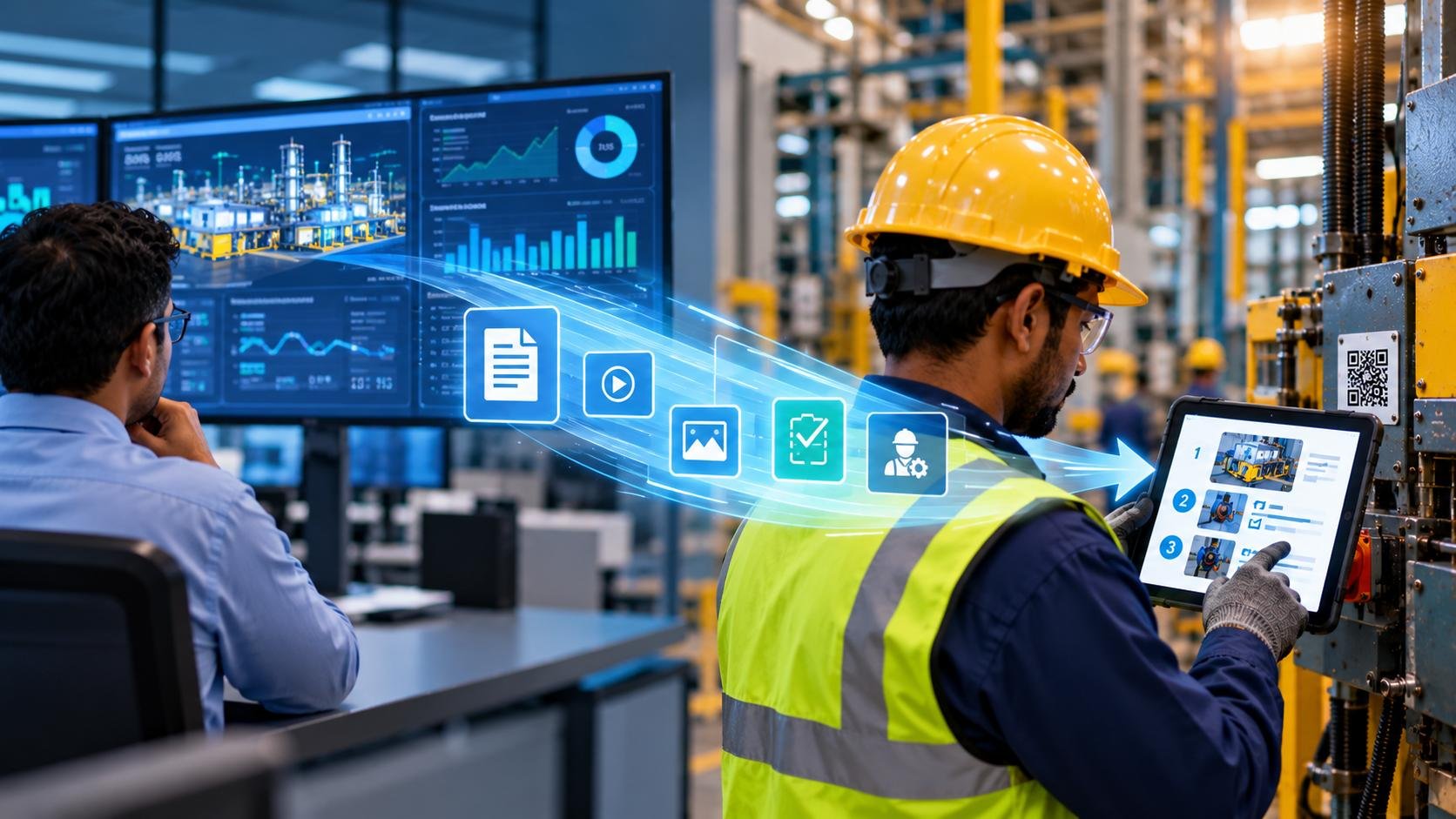
Digital Transformation in Manufacturing: Why the Last Mile Matters More Than Another Dashboard
Factories have dashboards, analytics and real-time reports. But does the worker at the machine have the right information at the right time? Why digital transformation must reach the last mile.

Last Mile - The Missing Link
Most companies invest in software to help management monitor operations, but often overlook the people who actually do the work on the shop floor. Many workers, especially contract employees, don't have easy access to the right information when and where they need it. This gap between what the system says and what happens on the ground can affect both safety and productivity.
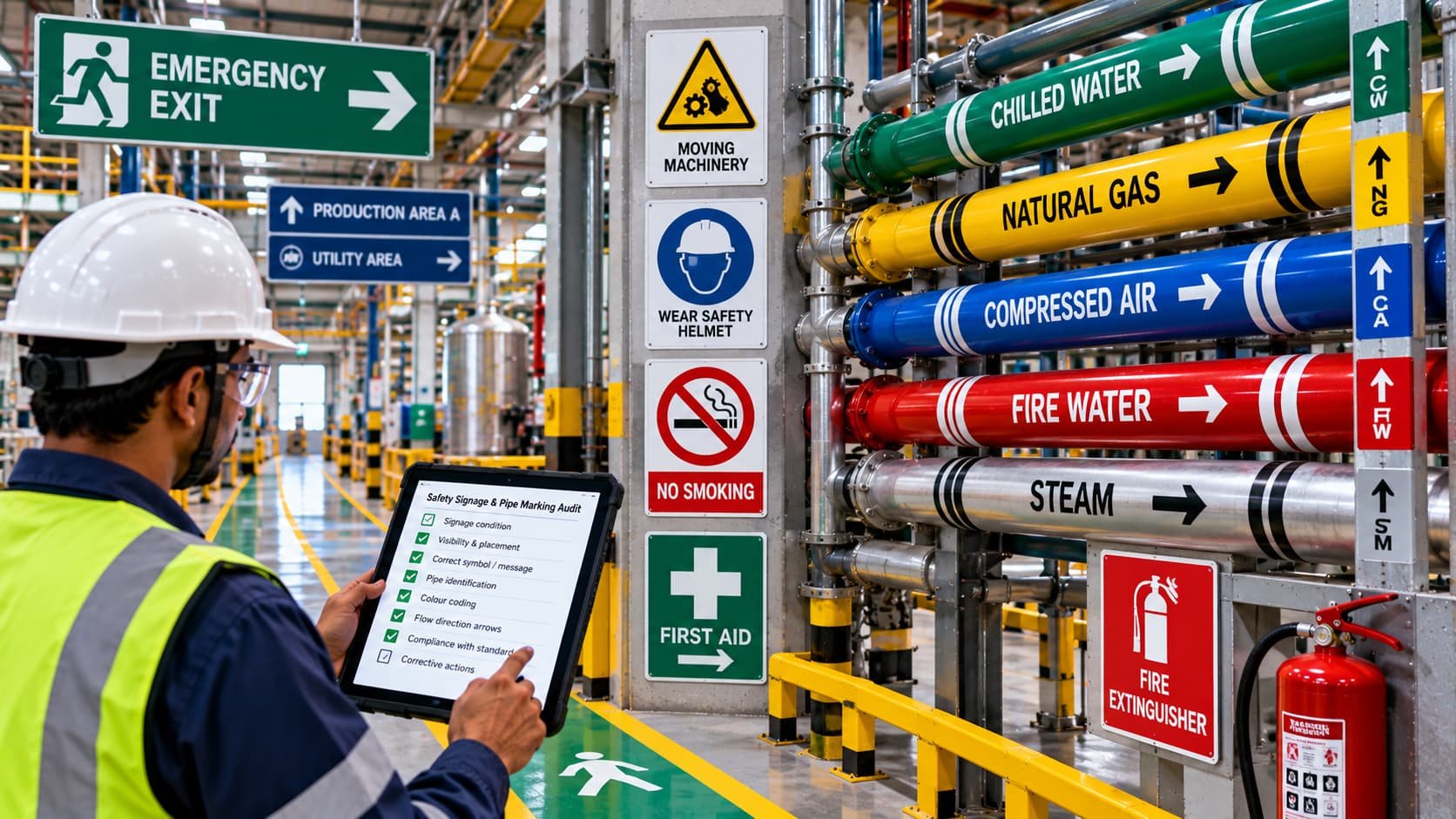
Safety Signage and Pipe Marking: When the Factory Itself Communicates Safety
A warning sign should not need an explanation. A pipeline should not need to be traced to understand what it carries. In a well-designed industrial workplace, critical information is visible before someone makes a decision.
Have a similar challenge on your site?
Tell us what you are trying to improve and we will help you find the practical next step.