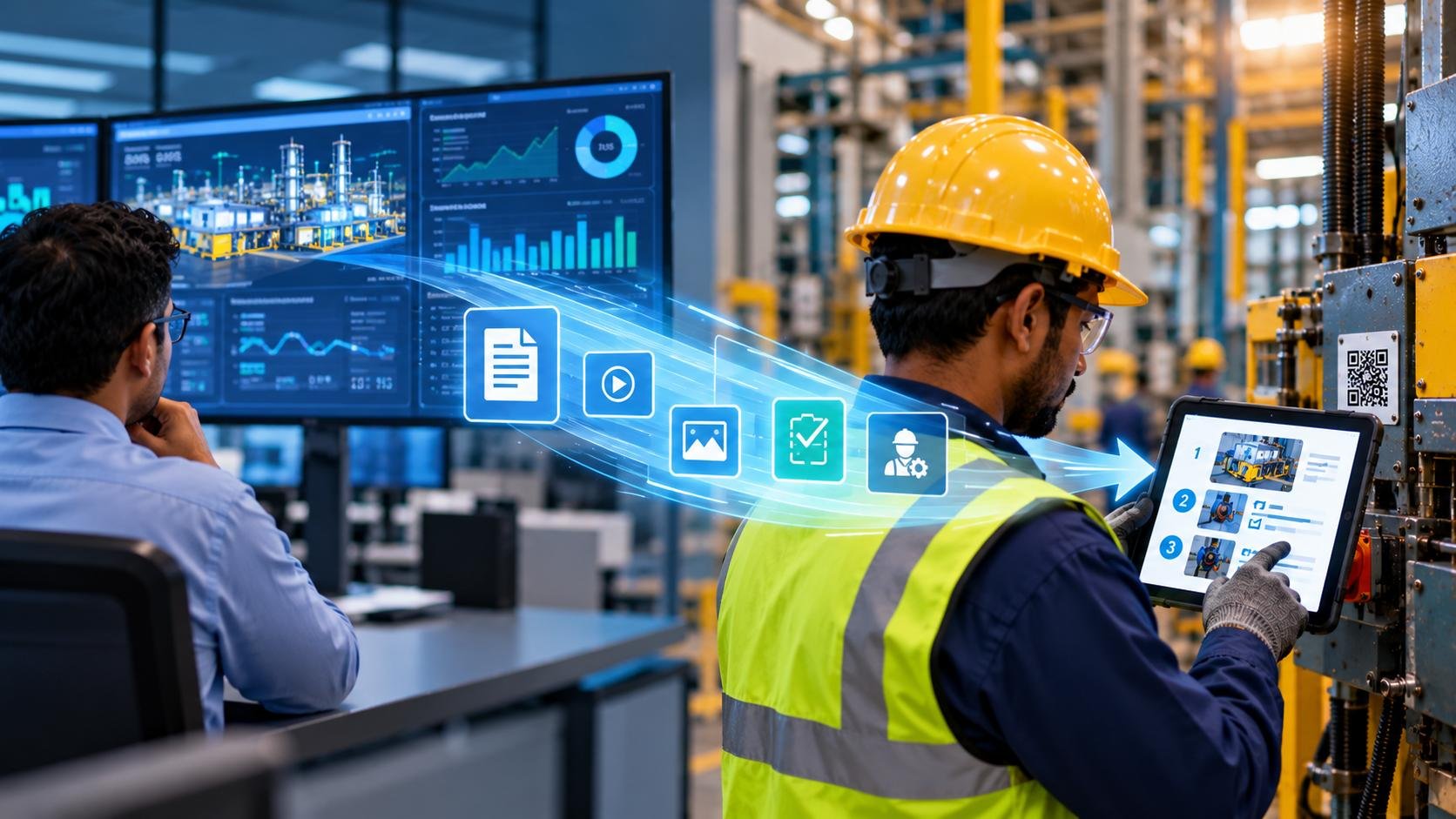
Walk into a modern factory, and you may find sophisticated dashboards, real-time production reports, automated alerts and powerful analytics. Management can see production figures, monitor performance and track operational efficiency from a screen.
But walk a little further onto the shop floor, and ask a simple question:
Does the worker operating the machine have the right information at the right time to do the job safely and correctly?
Surprisingly, the answer is not always yes. We first looked at this gap in Last Mile – The Missing Link.
The digital transformation gap
Manufacturing companies have invested heavily in digital transformation. ERP systems, MES platforms, IoT sensors, predictive maintenance and analytics have transformed how factories collect and process information.
Most of these investments help management plan, monitor and make decisions. They are valuable, but there is another part of the factory that often receives less attention: the last mile.
The last mile is where plans become actions, where procedures are executed, where machines are operated and where safety practices must work in the real world.
A production dashboard may tell a supervisor that a machine has stopped. But does the technician have immediate access to the correct troubleshooting procedure?
A safety system may store hundreds of approved SOPs. But can a contract worker find the right procedure before starting a maintenance task?
A training platform may record that an employee completed safety training. But can that person recall and access the relevant instructions when facing a hazard?
Digital transformation is incomplete when information reaches management but fails to reach the person who needs it to perform the work.
The people behind the production numbers
In many manufacturing facilities, a substantial proportion of the workforce consists of contract workers, outsourced personnel and frontline employees who spend their working hours away from desks.
They may not have individual computers, corporate email accounts or regular access to enterprise software. Some work in noisy environments, wear protective equipment, move between locations or communicate in languages other than the language used in official documentation.
Yet these workers operate equipment, carry out maintenance, follow procedures, inspect assets and respond to abnormal situations.
They are expected to follow the company's processes, but the digital tools supporting those processes may not be designed for their working conditions.
This creates a disconnect between the factory's digital systems and the people responsible for executing the work.
What does last-mile digitalization look like?
Last-mile digitalization means delivering useful information and actionable workflows directly to the workplace, in a form that workers can access and understand.
It is not simply about installing more screens. It is about making technology useful at the point of need.
Consider a few practical examples.
1. SOPs available at the machine
Instead of expecting a technician to search through folders or contact a supervisor, a machine-specific QR code or nearby kiosk can provide access to the current approved operating or maintenance procedure, subject to appropriate access controls.
2. Safety information where hazards exist
Digital signage and strategically placed visual instructions can communicate production updates, safety alerts, restricted areas, emergency procedures and other relevant information where people actually work.
3. Workflows that guide execution
Inspections, checklists, audit findings and corrective actions can be delivered through simple digital workflows. Workers can complete assigned tasks, record observations and submit evidence, while supervisors retain visibility into progress and outstanding actions.
4. Training that extends beyond the classroom
Digital learning and assessments can help workers revisit safety instructions, refresh their knowledge and demonstrate understanding. Training becomes more useful when it is connected to the tasks and hazards workers encounter.
5. Information that follows the shift
Operational information should not depend entirely on one supervisor being present or one worker remembering what was discussed during a handover. Accessible instructions, documented actions and appropriate notifications can help maintain continuity across shifts.
The objective is simple: reduce the distance between information and action.
Why another dashboard may not solve the problem
Dashboards are excellent for summarizing information, identifying trends and supporting management decisions. They should remain an important part of manufacturing technology.
But a dashboard and a frontline workflow solve different problems.
A dashboard may show that an inspection is overdue. A frontline workflow helps the assigned person perform the inspection, record the result and report a defect.
A management report may identify repeated safety observations. A workplace process helps workers understand the relevant precautions and enables supervisors to verify corrective actions.
A production system may detect a deviation. An accessible instruction can help an authorized operator follow the appropriate response procedure.
The greatest value comes when these capabilities work together: management has visibility, supervisors can coordinate execution, and frontline workers can access the information and tools required for their responsibilities.
The question is not whether a factory needs dashboards. It is whether its digital transformation goes beyond them.
Building a connected digital workplace
A connected digital workplace brings together the information, instructions and workflows that people need throughout their working day.
Depending on the facility, this may include:
- Digital SOPs and work instructions.
- Workplace navigation, floor markings and visual communication.
- Safety training and competency assessments.
- Asset inspections, audits and corrective actions.
- Permit to Work and hazardous-energy isolation workflows.
- Emergency response information and team coordination.
- Production updates and operational announcements.
These capabilities do not necessarily need to replace existing ERP, MES or other enterprise systems. They can complement them by making relevant information more accessible to the people executing work.
The implementation should also account for real-world constraints: shared devices, connectivity limitations, multiple languages, access permissions, shift patterns and the need to keep safety-critical information accurate and current.
Technology should adapt to the workplace, rather than expecting every worker to adapt to an office-style software experience.
FactoryOS: Taking digital operations to the last mile
At Brigs Espro Services, we believe digital transformation should extend beyond management systems and reach the people who make manufacturing operations happen.
FactoryOS is designed around this last-mile perspective, bringing together digital workplace capabilities that help organizations make information, instructions and workflows accessible where work happens.
Combined with Brigs' expertise in visual workplace systems and industrial safety, this approach connects the physical factory environment with its digital operations.
The goal is not to add another layer of software for the sake of digitization. It is to make the workplace more informative, processes easier to execute, and operational information more accessible to the people who need it.
The real measure of digital transformation
A factory can have advanced analytics, automated reporting and sophisticated management dashboards and still leave gaps in everyday execution.
The real test is what happens at the point of work.
Can the worker access the correct instruction? Can the technician follow the approved procedure? Can an inspection finding be acted upon and verified? Can critical information reach the right people across shifts?
These are the questions that connect digital investment to operational reality.
The next stage of manufacturing digitalization is not just about collecting more data or building better dashboards. It is about closing the gap between knowing what is happening and enabling people to do the right thing.
Because the true value of digital transformation is realized not only in the control room, but also on the factory floor.
About Brigs Espro Services
Brigs provides industrial workplace safety, visual workplace and digital workplace solutions. Through FactoryOS, Brigs helps organizations bring operational information, instructions and workflows closer to the people who need them.
Explore our solutions at brigsespro.com.
Related articles

Have a similar challenge on your site?
Tell us what you are trying to improve and we will help you find the practical next step.