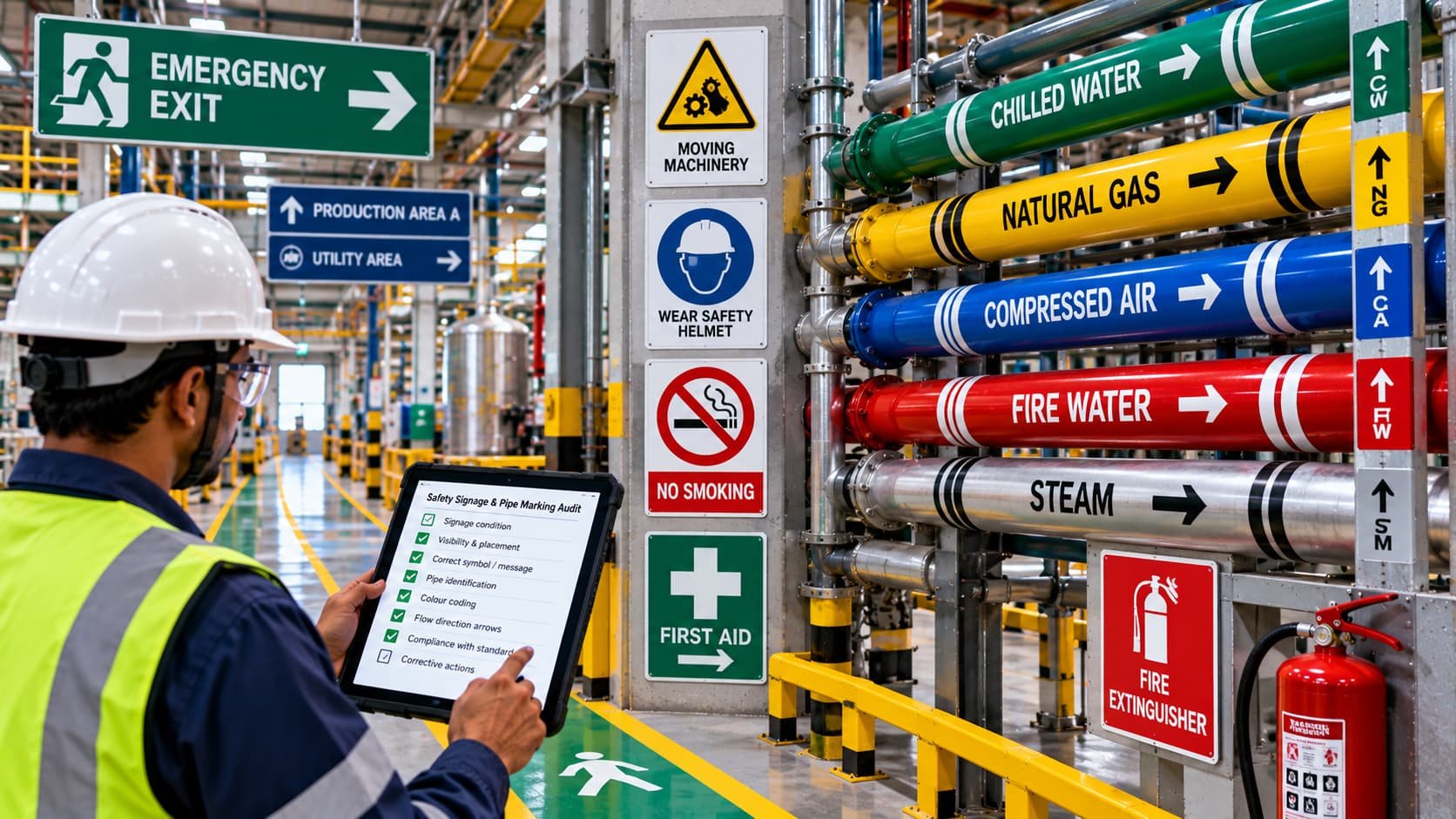
Imagine a maintenance technician entering an unfamiliar section of a factory.
Several pipes run overhead. Some carry water, others compressed air, steam, or process chemicals. A machine is operating nearby, a forklift crosses the aisle, and a restricted area lies just beyond the equipment.
The technician needs to identify the correct pipeline, understand the surrounding hazards, and reach the maintenance location safely.
How much of this information can be understood by simply looking around?
If the answer is very little, the workplace is relying too heavily on memory, verbal instructions, and assumptions.
This is where safety signage and pipe marking become important.
They are not merely decorative elements or compliance formalities. They are part of the factory's visual communication system — helping people recognise hazards, identify equipment, understand restrictions, and make safer decisions.
Why safety signage matters more than we think
Factories are dynamic environments. Employees, contractors, maintenance teams, visitors, and emergency responders may all need to interpret the same space, often with different levels of familiarity.
A permanent employee may know which machine is dangerous to approach. A contractor arriving for the first time may not. An experienced maintenance technician may recognise a pipeline from its route, while someone unfamiliar with the process may have no reliable way to identify it.
Safety signage reduces this dependence on individual knowledge.
A suitable warning sign can communicate a hazard before a person enters an area. A mandatory-action sign can indicate required precautions. An emergency sign can help someone locate an exit or first-aid facility.
The purpose is not to eliminate training or supervision. It is to ensure that important information remains visible even when the person encountering it is unfamiliar with the location.
Good safety signage makes hazards easier to recognise. Good pipe marking makes industrial systems easier to identify. Both reduce the need to guess.
1. Safety signs should communicate, not merely exist
The first question is not whether a sign has been installed. It is whether the intended person can recognise and understand it.
A factory may have dozens or hundreds of signs: electrical hazard warnings, mandatory PPE instructions, restricted-area notices, fire equipment identification, emergency exits, chemical warnings, and more.
But a sign can fail even when it is physically present.
It may be hidden behind a machine, faded by sunlight, obscured by stored materials, placed too far from the hazard, or designed with text that is difficult to read from the normal approach direction.
An audit should therefore examine the effectiveness of each sign, not simply count the signs installed.
Important questions include:
- Is the sign relevant to the hazard at that location?
- Can it be seen before a person reaches the hazardous area?
- Is the symbol or message easy to understand?
- Is the size appropriate for the viewing distance?
- Is the sign still accurate after changes to the process or layout?
- Is it maintained in a readable condition?
For example, a high-voltage warning should be placed where it meaningfully alerts people to the electrical hazard. A mandatory eye-protection sign should be visible before entering the area where eye protection is required.
The location of a sign is part of its effectiveness.
2. Understand the different types of safety signs
A consistent safety signage system distinguishes between different types of messages.
- Warning signs alert people to hazards that may cause injury, such as electrical danger, moving machinery, hot surfaces, or hazardous chemicals.
- Prohibition signs communicate actions that are not permitted, such as smoking in designated prohibited areas or unauthorised entry.
- Mandatory-action signs indicate precautions that must be followed, such as wearing safety helmets, eye protection, or hearing protection.
- Safe-condition and emergency signs help people identify emergency exits, first-aid facilities, safety showers, and other designated safety resources.
- Fire equipment signs identify firefighting equipment, alarm call points, hose reels, and related facilities.
The design, colours, shapes, symbols, and use of these signs should follow the applicable standards and the site's approved conventions.
A facility should avoid creating its own inconsistent variations when established safety symbols already exist. Familiarity helps people interpret information quickly.
Where the workforce speaks multiple languages, standardised symbols can improve understanding. Additional text in relevant languages may be appropriate where needed.
3. Pipe marking: Why colour alone is not enough
A pipeline is part of the process system. Its identification must be accurate enough to support safe decisions.
In a process industry, pipes carry the materials that keep the plant operating. These may include water, steam, compressed air, fuels, chemicals, hydraulic fluids, and many other process media.
Pipelines often run through congested areas, across multiple levels, and between interconnected systems. Some may be insulated or hidden behind equipment. Others may look almost identical from the ground.
Without a consistent identification system, workers may need to trace a line, consult drawings, or ask someone familiar with the process.
That can be inconvenient during routine work and potentially dangerous during maintenance or an emergency.
Pipe marking helps identify the contents of a line and, where appropriate, the direction of flow and relevant hazards.
A useful identification system may include:
- The name of the service or fluid.
- A standardised colour scheme.
- Arrows indicating the direction of flow.
- Hazard information where appropriate.
- Identification at valves, branches, junctions, and points where the line may be confused with another.
- Consistent identification across connected sections of the system.
The important distinction is that colour is a visual aid, not a substitute for accurate identification.
Two pipes should not be considered safe to distinguish merely because their paint colours appear different. Labels, flow arrows, and other appropriate identifiers help reduce ambiguity.
The markings must also remain accurate when a pipeline is modified, a service changes, or equipment is relocated.
4. Follow the applicable Indian standards
For Indian industrial facilities, two relevant standards to consider are:
- IS 2379:2024 — Colour Code for Pipeline Identification — Code of Practice (Second Revision). This is the current edition listed in the Bureau of Indian Standards catalogue and is relevant to designing a pipeline identification scheme.
- IS 9457:2025 — Safety Colours, Safety Signs and Accident Prevention Tags — Code of Practice. This edition was published in July 2025 and supersedes the earlier IS 9457:2005 edition. It addresses safety identification colours, sign design principles, and accident-prevention tags.
The BIS catalogue also lists IS 16449 (Part 1):2018, covering design principles for safety signs and safety markings, reviewed in 2024.
These references should be checked against the actual requirements applicable to the facility, including relevant industry-specific standards, regulations, contractual requirements, and approved engineering practices.
A common mistake is to select a colour scheme from an online chart without checking which standard or convention it follows. Different schemes may exist across industries and countries.
The objective is not to combine familiar colours from several sources. It is to implement a documented, consistent, technically appropriate system.
5. Where should pipe markings be installed?
A pipeline may be hundreds of metres long. Marking only one visible section may not provide enough information to identify it reliably throughout the facility.
Marking locations should be selected to help people identify the line at the points where the information is needed.
These may include:
- Pipe entry and exit points in rooms or process areas.
- Changes in direction and important branches.
- Valves and other operating points.
- Junctions where several similar lines run together.
- Equipment connections and isolation points.
- Locations where pipes cross walkways or enter congested areas.
- Areas where maintenance or emergency response personnel may need to identify the service.
The exact spacing and placement should follow the applicable standard and the site's risk assessment rather than an arbitrary distance applied to every pipeline.
Markings should be visible from the normal approach direction. If a line runs above head height, the identification may need to be positioned so that a person standing at floor level can read it.
Insulated pipes, outdoor installations, aggressive environments, and high-temperature systems may require suitable marking materials that withstand their operating conditions.
A well-designed scheme considers both what information is displayed and whether people can see it when they need it.
6. The danger of outdated or incorrect markings
An incorrect marking can be more dangerous than a missing one because it encourages people to trust inaccurate information.
Consider a pipeline that originally carried water but was later repurposed for another service. If the identification was not updated, a maintenance technician may make an incorrect assumption.
Similarly, a valve may be replaced, a pipeline rerouted, or a new connection added without the corresponding identification being revised.
These situations highlight the need for a controlled process.
Whenever a process or pipeline is modified, the relevant drawings, identification records, labels, flow arrows, and safety information should be reviewed and updated as required.
A pipe-marking audit should compare physical identification against reliable process documentation and verify discrepancies with competent personnel.
Workers should never rely on a colour or label alone to authorise an intervention. Before breaking into a line or carrying out maintenance, they must follow the approved isolation and verification and work-authorisation procedures.
Visual identification supports safe work; it does not replace it.
7. Common mistakes in safety signage and pipe marking
Many facilities have invested in signage and identification over the years, yet inconsistencies can develop as the site expands.
Common problems include:
- Different colour schemes in different departments. Workers moving between areas may encounter conflicting meanings for similar colours.
- Signs hidden by equipment or storage. The information exists but is not visible from where it is needed.
- Labels that are too small or poorly positioned. A marker that cannot be read from the normal access point has limited value.
- Missing flow arrows. The contents may be identified, but the direction of movement remains unclear.
- Unmarked branches and valves. Workers can identify the main line but struggle to distinguish connected services.
- Faded, damaged or missing signs. Exposure to weather, chemicals, heat, cleaning agents, and physical contact can degrade markings.
- Uncontrolled local additions. Departments introduce new signs or labels without updating the plant-wide standard.
- Outdated information after modifications. The physical installation changes, but the visual identification remains the same.
These are not merely cosmetic defects. Depending on the location and hazard, they can affect maintenance, operational decisions, emergency response, and access control.
8. How to conduct a safety signage and pipe-marking audit
A systematic audit should evaluate both the visual condition and the accuracy of the information.
Step 1: Establish the scope
Identify the buildings, process areas, utility systems, pipelines, access routes, and equipment included in the audit.
Prioritise high-risk locations, including hazardous chemical services, high-pressure systems, electrical installations, maintenance areas, and emergency routes.
Step 2: Review the applicable standards and site conventions
Examine the site's approved signage standards, pipe-identification scheme, engineering drawings, process documentation, and previous audit findings.
Confirm that the system follows the applicable requirements and that any site-specific conventions are clearly documented.
Step 3: Inspect signs in the field
Walk through the facility and check whether each required sign is present, relevant, legible, visible, and correctly positioned.
Record missing signs, damaged markings, obstructed information, inconsistent symbols, and locations where additional identification may be necessary.
Step 4: Verify pipeline identification
Compare the labels and colours on actual pipelines against the available drawings and reliable process information.
Check service names, flow arrows, branch identification, valve identification, and the consistency of markings along the route.
Where discrepancies are found, seek confirmation from the responsible engineering or operations personnel before recommending changes.
Step 5: Assess readability and accessibility
Check the signs from the perspective of the intended user.
Can a person approaching from the normal route see the warning? Can a maintenance technician identify the pipeline while standing in a safe position? Can the information be read under the expected lighting conditions?
Consider viewing distance, height, lighting, visual obstructions, and the environmental conditions affecting the marking.
Step 6: Record and prioritise findings
Document the location, type of deficiency, supporting evidence, potential consequences, and recommended corrective action.
A missing warning in a high-risk area may need immediate attention, whereas a minor defect in a low-risk informational sign may have a different priority.
Step 7: Correct and verify
Assign responsibility and deadlines. Replace damaged signs, correct inaccurate pipe identification, standardise inconsistent markings, and update controlled drawings or records where required.
Verify that the completed work resolves the original issue. A defect should not be considered closed simply because a new label has been ordered or a work order has been raised.
Step 8: Maintain the system
Include safety signs and pipe markings in periodic inspections. Review them whenever equipment, processes, hazards, or layouts change.
This prevents the visual workplace from gradually becoming inconsistent again.
9. Digital tools can help maintain visual safety information
For a large factory, keeping hundreds or thousands of signs, labels, and associated records accurate can be difficult.
Digital tools can support the process by maintaining asset and location registers, recording inspection findings, assigning corrective actions, and tracking closure.
For example, a digital inspection workflow may allow an auditor to record a damaged sign, attach a photograph, identify its location, assign a responsible person, and verify the replacement.
A controlled repository can also help ensure that approved signage designs and identification conventions are available to the people responsible for implementation.
Digital signage can complement physical signs by communicating temporary hazards, safety alerts, and changes in operating conditions.
However, permanent hazard warnings and critical pipeline identification should not depend solely on a digital display that may be switched off, unavailable, or displaying unrelated content.
The physical visual system remains essential. Digital tools help manage, update, and reinforce it.
Making the factory easier to understand
A factory should not require every worker to memorise the entire plant layout, every pipeline, and every hazard before being able to work safely.
Safety signage helps people recognise the risks around them. Pipe marking helps them understand the services running through the plant. Consistent symbols, colours, labels, and flow arrows reduce ambiguity.
But these systems only work when they are accurate, visible, standardised, and maintained.
At Brigs, we see visual workplace management as an essential part of industrial safety. The objective is to help organisations create environments where workers, contractors, maintenance teams, and visitors can interpret important information without unnecessary confusion.
This requires more than installing signs or painting pipelines. It requires a systematic approach to design, implementation, audit, maintenance, and communication.
A warning sign should be visible before someone encounters the hazard. A pipe marker should identify the service before someone makes an assumption. And the visual information should remain trustworthy throughout the life of the facility.
That is when safety signage and pipe marking become more than markings on a wall or pipe. They become part of the way the factory protects its people.
References and further reading
- Bureau of Indian Standards (BIS), IS 2379:2024 — Colour Code for Pipeline Identification — Code of Practice (Second Revision). Official BIS catalogue entry
- Bureau of Indian Standards (BIS), IS 9457:2025 — Safety Colours, Safety Signs and Accident Prevention Tags — Code of Practice. BIS standard information
- Bureau of Indian Standards (BIS), IS 16449 (Part 1):2018 — Graphical Symbols: Safety Colours and Safety Signs, Part 1: Design Principles for Safety Signs and Safety Markings. Official BIS catalogue entry
Note: The applicable standard and legal requirements depend on the facility, industry, process, and jurisdiction. Verify the current edition and relevant requirements before implementing a signage or pipeline-identification scheme.
Related reading

Have a similar challenge on your site?
Tell us what you are trying to improve and we will help you find the practical next step.