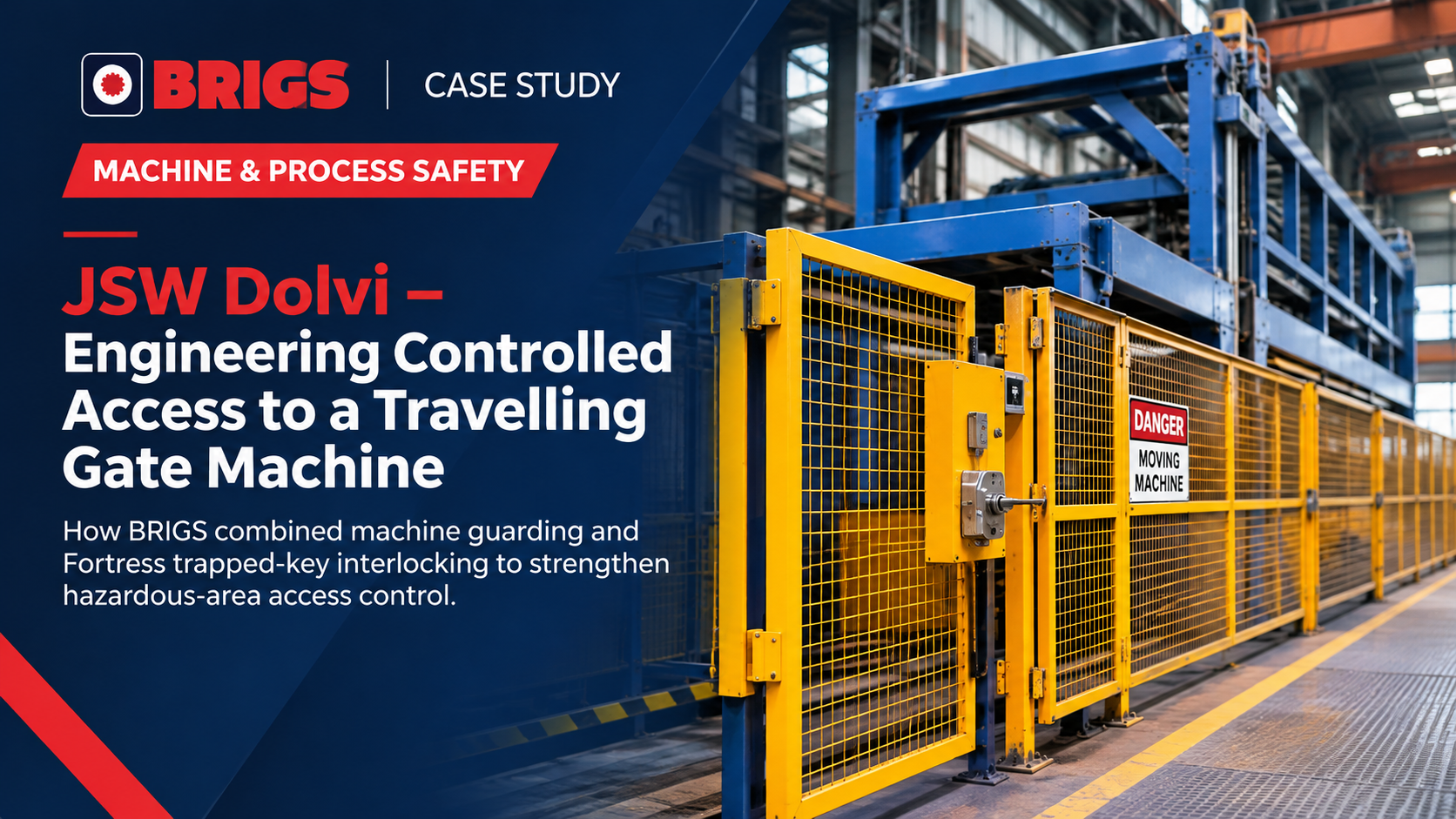
Safe access has to be engineered into the machine's operating sequence—not left entirely to procedure.
01 — The Brief
Strengthening Access Control Around the Travelling Gate
At JSW Dolvi, a housekeeping person entered the hazardous area of a Travelling Gate machine and suffered finger injuries following an unexpected machine start-up.
The requirement was to strengthen the machine's safeguarding arrangement, restrict unauthorised entry and prevent machine operation while personnel were inside the hazardous area. The arrangement also needed to support housekeeping, maintenance and other intervention activities.
02 — The Challenge
When Access and Machine Operation Are Not Adequately Linked
The incident exposed gaps in physical guarding and access control. Personnel access was not adequately linked to the control of the machine's hazardous movement.
The existing arrangement also presented visibility limitations and potential opportunities to bypass the intended safety sequence.
A physical guard alone was not enough. Access to the hazardous area and the machine's operating condition needed to be addressed together.
How can access be physically controlled so that personnel entry does not conflict with machine operation?
03 — The BRIGS Solution
Linking Isolation, Key Control and Access
BRIGS assessed the existing safeguarding arrangement, examining access points, personnel movement, physical guarding, visibility limitations and existing interlocks.
Based on the identified gaps, BRIGS recommended a combination of machine guarding and Fortress trapped-key interlocking.
The intended arrangement connected the required machine isolation conditions with the release of the key needed to access the guarded area.
Conceptual sequence:
Machine Isolation → Key Release → Controlled Access
This approach makes access dependent on a defined physical safety sequence rather than relying exclusively on written instructions or individual memory.
Relevant Machinery-Safety Standards
The engineering considerations relate to four machinery-safety standards:
- ISO 12100:2010 — Machinery risk assessment and risk reduction.
- ISO 14120:2015 — Design and selection of machine guards.
- ISO 14119:2024 — Interlocking devices associated with guards.
- ISO 14118:2017 — Prevention of unexpected machine start-up.
These standards address different aspects of machinery safety, including risk assessment, physical guarding, interlocking and unexpected start-up prevention. Their formal application to this installation must be confirmed against approved engineering and validation records.
04 — How BRIGS Implemented the Solution
BRIGS implemented the Fortress trapped-key interlocking solution alongside machine guarding, integrating it into the Travelling Gate's access and operating arrangement.
1- Assess the existing arrangement: Examine personnel access, machine operation and potential safeguarding gaps.
2- Strengthen physical protection: Implement machine guarding and controlled-access measures.
3- Introduce trapped-key interlocking: Establish a key-dependent sequence connecting the required isolation condition with access to the guarded area.
4- Link access with machine operation: Design the arrangement to prevent operation when the conditions required for safe personnel access are not satisfied.
5- Support intervention activities: Address access requirements associated with housekeeping, maintenance and other interventions.
05 — The Impact
A More Controlled Access and Operating Process
The intervention established a more structured relationship between isolation, key control and physical entry.
Controlled access: Physical entry brought under a defined safety sequence.
Protection against unexpected start-up: Machine operation linked to the conditions required for safe personnel access.
Reduced bypass opportunities: Physical interlocking strengthened the intended isolation and access sequence.
Stronger procedural control: The safety sequence became part of the engineered safeguarding arrangement.
Improved intervention safety: Housekeeping, maintenance and inspection activities supported by a more structured access-control process.
The documented impact is qualitative. Verified post-implementation incident figures or numerical performance measures were not available.
The BRIGS Approach
The project reflects the BRIGS approach to Machine & Process Safety:
SEE → CONNECT → DIAGNOSE → DESIGN → IMPLEMENT → IMPROVE
The focus was not simply on supplying an interlock. It was on engineering the relationship between the machine, the hazardous area and the person entering it.
The BRIGS Takeaway
Addressing the JSW Dolvi safety gap required more than reinforcing a procedure. It required an engineered arrangement connecting guarding, isolation and access control.
By combining machine guarding with Fortress trapped-key interlocking, BRIGS helped establish a more controlled approach to hazardous-area access.
When safe access is built into the machine's operating sequence, safety becomes part of the process—not simply a step written beside it.
That is the value of engineered machine safeguarding.
Related reading
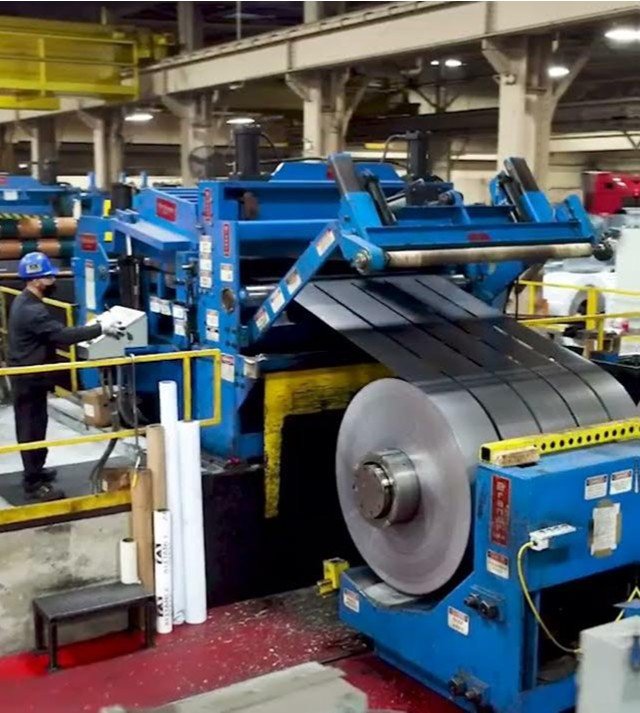
Enhancing Safety in the Recoiler Area of Steel Plants with The Trapped Key Interlock Solution
Brigs, in collaboration with Fortress, implemented a Trapped Key Interlock System in a steel plant to prevent accidents caused by unsafe interventions and unexpected machine startups. The solution ensures controlled machine access during maintenance, reduces reliance on procedural compliance, and improves safety. Extended to four additional slitter lines, it enhances operational continuity without compromising productivity.

The Symptom Is Not the System
Understand why factory incidents, errors and delays occur—and how to look beyond the visible problem to identify the conditions that need to change.

Understanding the Factory as a Process
Understand how people, machines, processes and information work together—and why gaps between them can disrupt everyday factory operations. Explore how BRIGS identifies these gaps and improves the workplace through Factory UX, Factory OS, safety and process improvement.
Have a similar challenge on your site?
Tell us what you are trying to improve and we will help you find the practical next step.