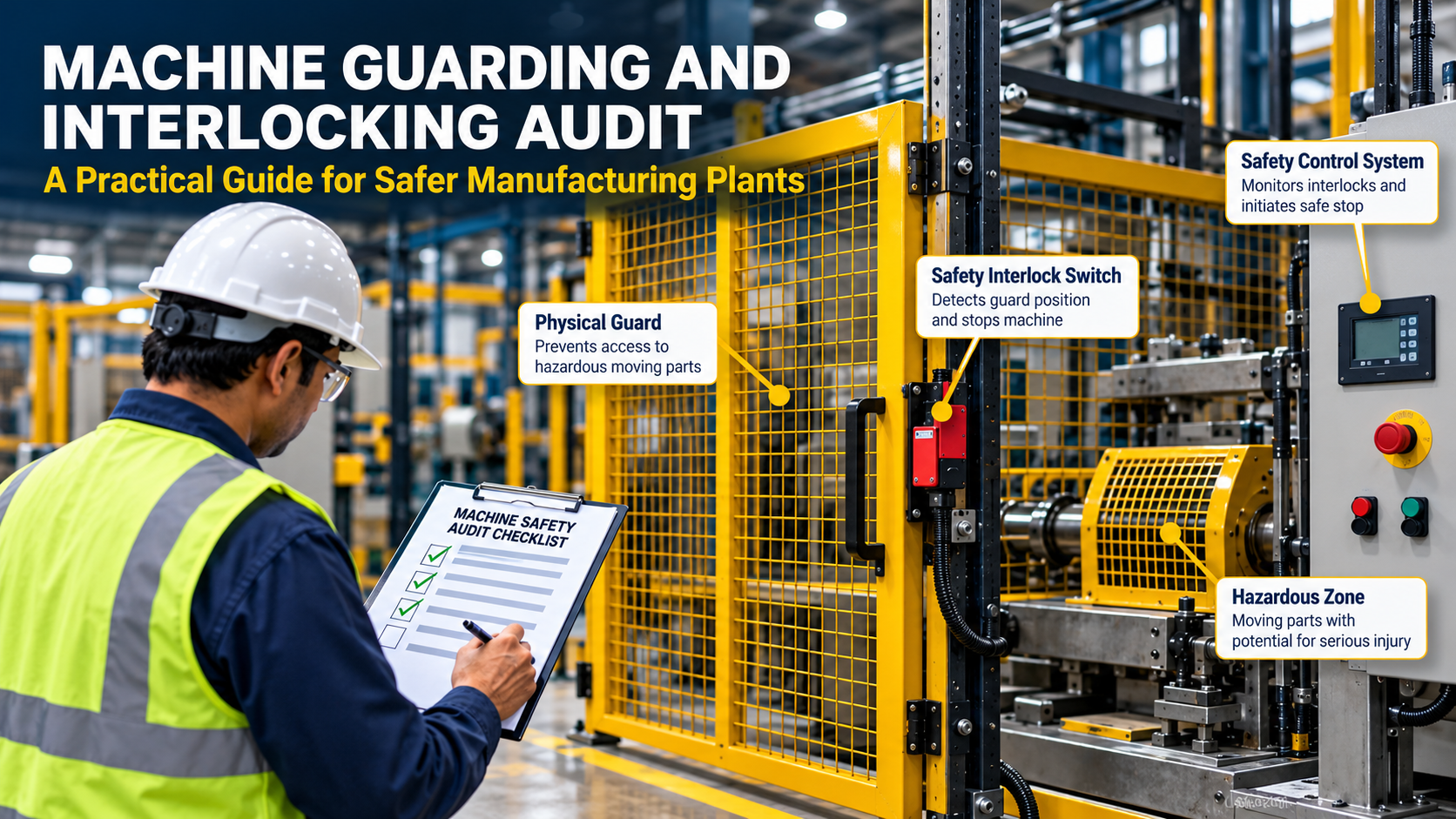
Introduction: Is Your Machine Really Safe?
Walk through a manufacturing plant and look at the machines around you.
You will probably find protective covers, metal enclosures, emergency stop buttons, safety switches and warning labels. Some machines may even have sophisticated electronic safety systems.
But here is an important question: Do these safeguards actually prevent access to danger, or do they simply give the appearance of safety?
A guard may be present but leave a gap large enough for a hand to enter. An interlock switch may be installed but positioned so that it can be easily defeated. A machine may stop when a door opens, yet continue moving long enough for a worker to reach the hazardous area before the movement ends.
In some plants, guards are removed during maintenance and never reinstalled properly. In others, operators bypass interlocks because frequent interruptions make production difficult.
These problems are not always obvious during a routine factory inspection.
A systematic machine guarding and interlocking audit examines the complete protective system: the hazard, the physical guard, the safety device, the machine control system, the stopping behaviour, and the way people actually operate and maintain the equipment.
The objective is not merely to check whether guards and switches exist. It is to determine whether the safeguards provide effective protection under foreseeable operating conditions.
1. Understanding Machine Guarding and Safety Interlocking
Before conducting an audit, it is important to understand the roles of the two main protective measures.
What is machine guarding?
Machine guarding is the use of physical barriers or protective devices to prevent people from contacting hazardous machine parts.
Common examples include:
- Fixed guards covering belts, pulleys, gears, shafts and couplings.
- Enclosures around cutting, punching, shearing and forming operations.
- Perimeter fencing around robotic cells and automated production lines.
- Adjustable guards on machines where the workpiece or operation changes.
- Protective devices such as light curtains, pressure-sensitive devices and other suitable presence-sensing systems.
A well-designed guard prevents access to the hazard while allowing the machine to perform its intended function.
What is safety interlocking?
An interlocking system connects a movable guard, access door or other protective barrier to the machine's control system.
Depending on its design, the system prevents hazardous operation when the guard is open, initiates a protective stop when the guard is opened, or keeps the guard locked until the hazardous movement has stopped.
For example, consider an automated packaging machine with an access door.
When the door is opened, the interlocking system should initiate the required protective response. The machine must not continue hazardous operation in a way that exposes the person opening the door to danger.
If hazardous movement takes time to stop, a guard-locking arrangement may be necessary to prevent access until the movement has ceased.
Closing the guard must not, by itself, cause an unexpected machine restart.
The precise requirements depend on the machine, the hazard, the safety system design and the applicable standards.
Why both are necessary
A physical guard without an appropriate interlock may allow access while the machine is still moving whenever the guard is opened.
An interlock without an effective physical guard may leave gaps through which a person can reach the hazardous area without opening the protected door.
A functioning switch also cannot compensate for an incorrectly designed safety circuit or inadequate stopping performance.
The audit must evaluate the complete safeguarding arrangement, not each component in isolation.
2. What Hazards Should a Machine Safety Audit Identify?
The first step is to identify the hazardous movements, energy sources and access points associated with the machine.
2.1 Rotating parts
Exposed shafts, couplings, gears, flywheels, spindles and other rotating components can catch clothing, hair, fingers or other body parts.
Even apparently smooth components can create serious entanglement hazards.
The audit should identify exposed rotating components, missing covers, inadequate openings and areas where a worker can reach moving parts during normal operation or cleaning.
2.2 In-running nip points
Nip points occur where moving parts converge or where a moving component passes close to another surface.
Typical examples include:
- Conveyor belts and rollers.
- Rollers in steel mills and paper machines.
- Belt and pulley arrangements.
- Gears, chains and sprockets.
- Feed rollers in packaging and processing equipment.
These hazards can pull a hand or clothing into the machine, causing crushing injuries or amputations.
2.3 Cutting, crushing, shearing and punching hazards
Presses, shears, cutters, stamping machines, moulding machines and similar equipment can expose workers to severe injury at the point of operation.
The audit must consider how the workpiece is loaded and removed, whether operators can reach the danger zone during the operating cycle, and whether the protective arrangement remains effective for all intended operating modes.
2.4 Robotic and automated equipment
Robotic cells and automated production lines introduce additional hazards.
A person may enter a cell during setup, fault recovery, cleaning or maintenance. The robot may restart automatically when a fault is cleared or a cycle resumes unless the control system is designed to prevent this.
The audit should consider perimeter fencing, access gates, presence-sensing devices, trapped-person risks, reset locations, unexpected restart and the relationship between robot motion and other connected equipment.
2.5 Stored and residual energy
Stopping the motor does not necessarily eliminate the hazard.
A machine may contain:
- Rotating parts that continue moving after power is removed.
- Hydraulic or pneumatic pressure.
- Suspended loads or gravity-driven movement.
- Springs under tension or compression.
- Hot surfaces or hazardous process materials.
- Electrical energy stored in capacitors or other components.
The audit must distinguish between protective stopping during normal access and the isolation procedures required for servicing, maintenance or work that exposes people to hazardous energy.
An interlock is not a substitute for lockout/tagout (LOTO) where hazardous energy isolation is required.
3. Define the Scope Before Starting the Audit
An effective audit begins with a clear scope.
Trying to inspect every machine in a large plant without a structured plan often produces incomplete records and inconsistent assessments.
Start by preparing a machine register containing:
- Machine identification number and description.
- Department, production line and physical location.
- Manufacturer, model and year, where known.
- Operating purpose and production process.
- Normal operators and maintenance personnel.
- Existing guards, interlocks and other safety devices.
- Known incidents, near misses and recurring safety observations.
- Maintenance, modification and bypass history, where available.
Include standalone machines as well as connected equipment and automated production lines.
Pay particular attention to machines that are frequently accessed for adjustment, cleaning, jam removal or fault recovery. These activities may expose workers to hazards that are not apparent during normal production.
Prioritize machines by risk
Not every machine requires the same level of audit effort.
A practical prioritization considers the severity of possible injury, the likelihood and frequency of exposure, and the possibility of avoiding the hazard.
Machines with accessible cutting or crushing points, frequent manual intervention, known bypasses, serious incidents or uncontrolled hazardous movement should receive early attention.
The risk-ranking method should be defined consistently across the plant and aligned with the organization's risk assessment process.
4. The Step-by-Step Machine Guarding and Interlocking Audit
Step 1: Identify hazards and people at risk
Observe the machine in its actual working environment.
Identify hazardous movements, points of operation, nip points, transmission components, ejection hazards and stored energy.
Then identify who may be exposed.
This includes more than the machine operator. Maintenance technicians, cleaning personnel, contractors, material handlers and people working near the machine may also be at risk.
Consider the full lifecycle of the task:
- Normal production.
- Loading and unloading.
- Tool changes and adjustments.
- Cleaning and lubrication.
- Jam clearing and fault recovery.
- Inspection and maintenance.
- Setup, commissioning and troubleshooting.
A machine that appears safe during automatic production may become hazardous when a worker reaches inside to clear a jam.
Audit question: Have all foreseeable tasks and access scenarios been considered, or has the assessment focused only on normal production?
Step 2: Inspect the physical guards
Examine every guard intended to prevent access to hazardous parts.
Check whether the guard:
- Covers the complete intended danger zone.
- Prevents access through gaps, openings and around its edges.
- Is securely mounted and sufficiently strong for its purpose.
- Has no missing fasteners, damaged panels or bent sections.
- Cannot be displaced easily during normal operation.
- Does not create sharp edges, pinch points or other hazards.
- Allows adequate visibility where required for safe operation.
- Remains effective after routine cleaning and maintenance.
Check both the operator-facing side and other accessible sides of the machine.
A guard that protects the front of a conveyor but leaves the return rollers accessible from the rear is incomplete.
For fixed guards, assess whether routine removal is genuinely necessary. If access is required frequently, a properly designed movable guard with an appropriate interlocking arrangement may be more suitable.
The audit should also check that a guard has not been modified in a way that compromises its protective function.
Step 3: Verify the adequacy of guard openings and access distances
The presence of a guard does not automatically mean that access to the hazard has been prevented.
A mesh enclosure, for example, may have openings that are too large for the distance between the guard and the hazardous component.
A gap below a conveyor guard may allow a worker to reach an in-running nip point. An opening around a machine feed may expose a hand to the point of operation.
Assess openings, distances, reach paths and access from different directions using the requirements applicable to the machine and its protective arrangement.
Do not rely on visual judgement alone where dimensions or reach distances are safety-critical. Record measurements and verify them against the relevant technical requirements.
The audit should also consider foreseeable attempts to reach around, over, under or through the guard.
Step 4: Identify every movable guard and interlock
Prepare an inventory of access doors, movable panels, interlocked gates and other protective devices.
For each interlocking arrangement, record:
- The guard or access point being protected.
- The type and identification of the interlocking device.
- The hazard or hazardous movement controlled.
- The machine function that should be prevented or stopped.
- Whether guard locking is required.
- The intended reset and restart behaviour.
- The safety control system associated with the device.
- The inspection and test requirements.
Interlocking devices may use mechanical, electromechanical, electronic, magnetic, RFID-based or other technologies.
However, selecting a particular technology does not automatically make the system safe. Suitability depends on the risk assessment, device characteristics, installation, control architecture and the possibility of foreseeable defeat.
Step 5: Check installation and mechanical condition
Inspect each interlock and its associated guard.
Look for:
- Loose or damaged switches.
- Misaligned actuators.
- Broken brackets or mounting hardware.
- Damaged cables and connectors.
- Excessive movement of the guard.
- Unreliable engagement or disengagement.
- Signs of impact, contamination or environmental deterioration.
- Improvised repairs or unauthorized modifications.
The actuator and sensor must remain correctly positioned throughout normal guard movement.
A switch that operates only when the door is pushed or held in a particular position may indicate poor installation or mechanical wear.
The audit should establish whether the device is suitable for the operating environment and whether the installation follows the manufacturer's instructions and the intended safety design.
Step 6: Test the interlocking function
Functional testing is a critical part of the audit. Visual inspection alone cannot establish whether the complete system works correctly.
Testing must be performed by competent, authorized personnel using a documented, machine-specific procedure.
The procedure should define safe test conditions, required machine states, expected responses, acceptance criteria and actions to take if the test fails.
Depending on the machine and system design, the verification may include:
A. Guard-open prevention test
Verify that the machine cannot initiate the relevant hazardous operation when the guard is open.
B. Guard-opening response test
Under the approved test procedure, verify that opening the guard produces the intended protective response.
Do not place a person inside a danger zone or use unsafe live testing to demonstrate this function.
C. Guard-locking test
Where guard locking is required, verify that access remains prevented until the conditions specified by the safety design have been met.
D. Restart behaviour test
Verify that closing the guard does not itself initiate an unexpected restart. Check the reset and start controls according to the machine's intended safety design.
E. Fault response verification
Where required by the risk assessment and safety system design, verify that relevant faults are detected and that the system responds as intended. This may require controlled testing by a qualified machinery safety engineer.
F. Stopping performance
Determine whether the hazardous movement stops within the time required to prevent access to the danger before the hazard has ceased.
Where the assessment depends on stopping time, use an appropriate measurement method and compare the result with the calculated or specified safety requirement.
A motor stopping is not necessarily the same as a hazardous movement stopping.
Record the actual result, the expected result, the test conditions and any limitations.
If a safety function fails, do not simply reset the fault and continue production. Follow the plant's safe shutdown and corrective action procedure.
Step 7: Assess the possibility of defeating the interlock
An interlock may function correctly during a basic test and still be vulnerable to defeat.
For example, workers may use an improvised actuator, a spare switch, a magnet or another means of keeping the safety circuit in a permissive state while the guard remains open.
The audit should look for evidence such as:
- Improvised actuators or spare devices near the machine.
- Loose or disconnected interlocks.
- Switches mounted where they can be easily manipulated.
- Repeated interlock faults followed by bypasses.
- Production practices that encourage operation with guards open.
- Unapproved changes to safety wiring or control logic.
The objective is not to assume deliberate misconduct. It is to understand why defeating the safeguard may be possible or attractive.
Frequent bypassing may indicate poor access design, inadequate maintenance, recurring process problems or production targets that conflict with safe working practices.
The corrective action must address the underlying cause as well as the immediate defect.
Do not intentionally defeat an interlock during an audit unless a specific, engineered test procedure has been approved and appropriate safeguards are in place.
Step 8: Review the safety control system
The interlock switch is only one part of the complete protective system.
Depending on the risk assessment, the safety function may include the sensing device, safety relay or safety controller, output devices, contactors, drives, brakes and associated feedback or diagnostics.
The audit should establish whether the safety-related control system is appropriate for the required risk reduction and whether the installed arrangement matches the documented design.
Where relevant, review:
- Safety circuit drawings.
- Safety relay or controller configuration.
- Required Performance Level (PLr) or Safety Integrity Level (SIL), where applicable.
- Diagnostic and fault-detection provisions.
- Redundancy and monitoring requirements.
- Reset logic and restart prevention.
- Changes to control logic or wiring.
- Validation records and previous test results.
Do not assign a PLr or SIL based on guesswork, and do not assume that a safety-rated component makes the entire circuit adequate.
Where the design or its safety integrity cannot be established, escalate the issue for competent engineering assessment.
Step 9: Examine maintenance and hazardous energy isolation
Machine guarding and interlocking audits must include the boundary between normal access and maintenance work.
An interlocked guard may be suitable for certain routine interventions, but it may not isolate all hazardous energy sources.
For maintenance, repair, cleaning or other tasks that expose people to hazardous energy, review the applicable isolation procedure.
Check whether the procedure identifies all relevant energy sources, specifies the isolation points, addresses stored energy, prevents unexpected re-energization and requires verification of the safe state.
Where applicable, examine the use of personal locks, tags, group isolation arrangements and permit-to-work controls.
Pay particular attention to hydraulic and pneumatic pressure, gravity, thermal energy, rotating inertia and electrical energy stored after disconnection.
A machine must not be considered safe for maintenance merely because its control panel indicates that it is stopped.
Step 10: Observe actual working practices
Speak with operators and maintenance personnel. Observe the work without placing anyone at risk.
Ask questions such as:
- When do you need to open this guard?
- What happens when material becomes jammed?
- How do you clean or adjust the machine?
- What do you do when an interlock repeatedly trips?
- How is the machine made safe before maintenance?
- Who is authorized to reset faults or modify safety devices?
Compare the documented safe method with actual practice.
If workers routinely reach through an opening to remove material, the audit should examine both the physical access hazard and the production process that creates the need for intervention.
A useful audit does not stop at finding non-compliance. It identifies practical changes that make safe operation achievable and repeatable.
5. How to Classify and Prioritize Findings
A long list of observations is not useful unless the organization knows which problems require immediate action.
Each finding should describe the hazard, the existing safeguard, the observed deficiency, the possible consequence and the corrective action required.
A risk-based classification might use the following categories:
Critical — Immediate danger
A person can access a serious hazard without effective protection, or a required safety function has failed in a way that creates an immediate unacceptable risk.
Stop the affected operation or implement an approved safe condition immediately. Restart only after the required corrective action and verification have been completed.
High — Significant safeguarding deficiency
A major guard is inadequate, an interlock is unreliable, or a safety function does not meet its specified requirements.
Apply appropriate interim controls and establish a priority corrective action plan based on the assessed risk.
Medium — Degradation or incomplete protection
Examples may include deteriorating guard fixings, minor damage or documentation gaps that affect the ability to maintain safety.
Correct within a defined period based on risk, and implement interim measures where necessary.
Low — Improvement or administrative action
Examples may include improving identification, inspection records or maintenance documentation where the deficiency does not represent an immediate significant exposure.
The categories must be defined by the site's risk assessment procedure. A serious hazard must never be downgraded simply because the repair is inconvenient or expensive.
6. The Machine Guarding Audit Checklist
The following checklist can be used as a starting point for a machine-specific inspection. It does not replace a formal risk assessment or engineering validation.
A. Machine and hazard identification
- Machine ID, location and operating purpose recorded.
- Relevant machine documentation reviewed.
- Hazardous movements and points of operation identified.
- Operators, maintenance personnel and other exposed people identified.
- Production, cleaning, setup and maintenance tasks considered.
- Known incidents, bypasses and recurring faults reviewed.
B. Physical guarding
- All required guards are present.
- Hazardous moving parts and transmission components are adequately guarded.
- Guards prevent access through and around openings.
- Guard distances and openings are verified where required.
- Guards are securely mounted and in good condition.
- No unauthorized holes, modifications or missing fasteners.
- Guards do not introduce additional hazards.
- Access from all relevant directions has been considered.
C. Interlocking devices
- All relevant movable guards and access doors identified.
- Interlock devices are securely mounted and correctly aligned.
- Switches, actuators, cables and connectors are in good condition.
- The machine cannot initiate the relevant hazardous operation with the guard open.
- Opening the guard produces the required protective response.
- Guard locking is provided where required.
- Hazardous movement has stopped before access is permitted where necessary.
- Closing the guard does not cause an unexpected restart.
- Reset and restart functions behave as intended.
- Relevant faults and diagnostics are verified according to the test plan.
- Evidence of bypassing or defeat has been investigated.
D. Control system and energy isolation
- Safety control architecture is documented where required.
- Safety devices and outputs match the approved design.
- Relevant validation and test records are available.
- Safety-related modifications are controlled and documented.
- Maintenance isolation procedures cover relevant energy sources.
- Stored and residual energy is addressed.
- Isolation and safe-state verification requirements are understood.
E. Operational practices and records
- Operators understand the purpose of the safeguards.
- Maintenance personnel understand the relevant isolation procedures.
- Recurring faults and bypass incentives have been investigated.
- Findings are risk-ranked and assigned to responsible owners.
- Corrective actions have deadlines.
- Repairs and modifications are verified before release.
- Inspection and revalidation schedules are established.
For each item, record Pass, Fail, Not Applicable, or Requires Further Assessment, along with evidence and comments. A checklist item marked Pass should be supported by the appropriate inspection or test evidence, not simply an assumption.
7. Documentation: What Should an Audit Report Contain?
A useful machine safety audit report should allow the plant to understand the findings, act on them and demonstrate that corrective work has been completed.
For each finding, record:
- Machine ID: Unique machine or equipment reference.
- Location: Department and production line.
- Hazard: The hazardous movement or energy source.
- Safeguard: Existing guard, interlock or safety function.
- Finding: Specific observed deficiency.
- Evidence: Photograph, measurement, test result or drawing reference.
- Risk rating: Classification under the approved risk assessment method.
- Corrective action: Required engineering or operational improvement.
- Responsible person: Assigned action owner.
- Target date: Approved completion deadline.
- Verification: Evidence that the correction is effective.
- Closure approval: Authorized person confirming closure.
Photographs can be valuable evidence, particularly when they show the location of a missing guard, a damaged mounting bracket or an access gap.
However, photographs cannot establish the internal logic or functional integrity of a safety circuit. Those require appropriate technical evidence and testing.
The report should also distinguish between an observation, a confirmed failure and a matter that requires further engineering assessment.
8. Corrective Actions: Fix the Hazard, Not Just the Symptom
Once the audit is complete, the next step is to develop a practical improvement plan.
Consider a conveyor with an exposed return roller. The immediate observation may be a missing guard, but the root cause could be repeated access for cleaning or a guard design that is difficult to remove and reinstall.
A sustainable corrective action may require a redesigned guard, safer cleaning access, a suitable interlocking arrangement or a change to the cleaning procedure.
Similarly, if a machine interlock is frequently bypassed because of recurring false trips, replacing the switch alone may not solve the problem. The cause could be misalignment, vibration, an unsuitable device, a control-system fault or an incorrect application design.
For every major finding, consider:
- Can the hazard be eliminated through a design or process change?
- Can access be prevented with an appropriate fixed guard?
- If frequent access is necessary, is a suitable interlocked movable guard required?
- Does the safety control system provide the required risk reduction?
- Are stopping time and guard locking adequate for the hazard?
- Are maintenance, isolation and fault-recovery procedures effective?
- Does the corrective action need validation or revalidation by a competent engineer?
Administrative controls, warning signs and personal protective equipment may have supporting roles, but they should not be used as substitutes for required machine safeguards.
9. How Often Should Machine Guarding and Interlocking Audits Be Conducted?
There is no single inspection interval that is appropriate for every machine and every safeguard.
The frequency and depth of inspection should be determined by the machine's risk, the manufacturer's recommendations, the operating environment, the amount of use, the history of faults and the consequences of safeguard failure.
A practical plant programme may include:
- Pre-use checks: Operators check for obvious damage, missing guards or abnormal conditions before using equipment, as appropriate to the machine.
- Periodic inspections: Designated personnel inspect guard condition, mounting, interlocks and other safety-critical components according to the defined inspection schedule.
- Functional verification: Safety functions are tested at specified intervals using the approved procedure.
- Event-triggered review: A reassessment is carried out after a significant modification, a serious incident, repeated safety-device failure, changes in the process or evidence that the original risk assessment is no longer adequate.
These activities are complementary. A quick visual check cannot replace a detailed functional test, and a periodic audit cannot compensate for a defective safeguard that remains in service.
10. Standards and Technical References
The audit method should be aligned with applicable Indian legal requirements, relevant industry-specific regulations, the machine manufacturer's instructions and recognized machinery safety standards.
Useful technical references include:
- ISO 12100 — Safety of machinery: risk assessment and risk reduction.
- ISO 14120 — Safety of machinery: general requirements for the design and construction of guards.
- ISO 14119:2024 — Safety of machinery: interlocking devices associated with guards, including principles for design and selection and measures to minimize defeat.
- ISO 13849-1 — Safety-related parts of control systems: design principles and performance levels.
- IEC 62061 — Functional safety of safety-related control systems for machinery.
- ISO 14118 — Prevention of unexpected start-up.
- Applicable Indian Standards and statutory requirements relevant to the machine, industry and site.
The relevant editions, scope and applicability must be verified for the machine and jurisdiction. A reference to a standard alone does not establish that a machine is compliant; the actual design, risk assessment, installation and validation must be examined.
Useful public guidance:
- OSHA, Machine Guarding
- UK Health and Safety Executive, Introduction to machinery safety
- ISO, Interlocking devices associated with guards — ISO 14119:2024
11. Turning the Audit into a Continuous Machine Safety Programme
A one-time audit can identify problems, but long-term improvement depends on how the findings are managed.
A mature machine safety programme should maintain a central machine register, a risk-based inspection schedule, a record of safety-critical devices, a corrective action workflow and documented verification of completed work.
Every significant finding should have an owner and a clear closure criterion.
Changes to machine design, control logic, guards and interlocks should be reviewed through a controlled change-management process. Following a significant change, the affected risk assessment and safety functions should be reviewed and validated as appropriate.
Inspection results should also be analysed for recurring patterns.
For example, if interlock failures occur repeatedly across a particular production line, the organization should examine whether the underlying cause is poor device selection, vibration, contamination, installation quality, maintenance practices or operating procedures.
This approach turns the audit from a compliance exercise into a tool for improving reliability, reducing exposure to injury and strengthening operational discipline.
Conclusion: A Guard Is Only as Good as the Protection It Provides
Machine safety cannot be established by counting guards or checking whether interlock switches are installed.
A reliable audit asks deeper questions:
Can a person reach the hazard? Does the guard remain effective during actual work? Does the interlocking system produce the required protective response? Can the system be defeated? Does hazardous movement stop in time? Are maintenance and energy isolation properly controlled? And are corrective actions verified before the machine returns to service?
Answering these questions requires a combination of practical inspection, risk assessment, functional testing, engineering knowledge and an understanding of how machines are actually used.
For manufacturing organizations, the goal should be to build a machine safety system in which effective safeguarding is part of machine design, maintenance and everyday production—not something checked only during an inspection.
How BRiGS can help
BRiGS supports industrial organizations in strengthening workplace safety through machine and process safety assessments, practical safeguarding improvements and integrated safety solutions.
A systematic machine guarding and interlocking assessment can help identify gaps in physical protection, evaluate safety-device performance, prioritize corrective actions and establish a structured programme for verification and ongoing improvement.
The objective is simple: ensure that machine safeguards protect people in real working conditions, not just on paper.
If your plant is planning a machine safety assessment or reviewing its existing guarding and interlocking arrangements, contact BRiGS to discuss the scope and requirements of your facility.
Plan a Machine Safety Assessment with BRiGS.
Safety note: This article provides general educational guidance. It is not a substitute for a machine-specific risk assessment, the manufacturer's instructions, applicable statutory requirements or validation by competent machinery safety professionals.
Have a similar challenge on your site?
Tell us what you are trying to improve and we will help you find the practical next step.